
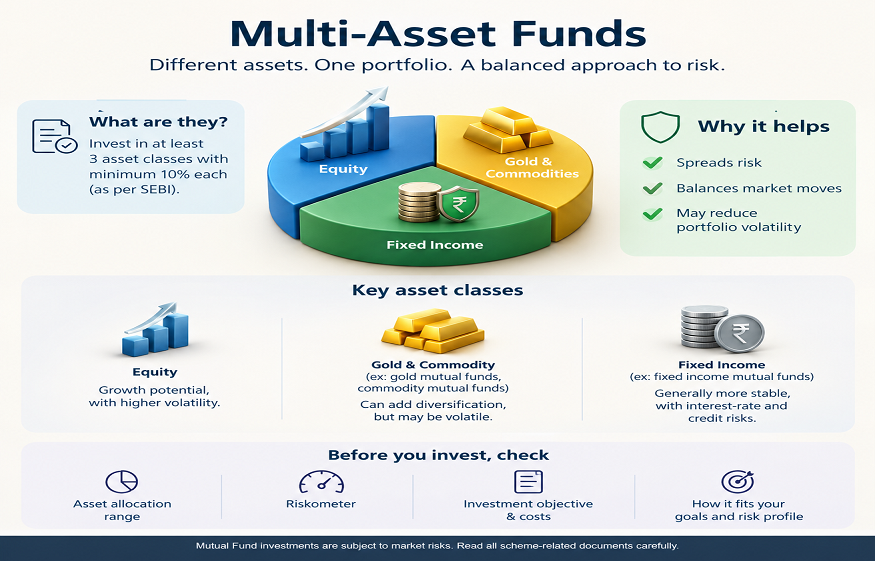
For investors seeking diversification, multi asset funds can offer a way to combine different asset classes within one mutual fund portfolio. The idea is simple: the scheme multispreads exposure across assets that can behave differently under changing market conditions.
Under SEBI’s mutual fund categorisation framework, a Multi Asset Allocation Fund invests in at least three asset classes, with a minimum allocation of 10% to each. The actual mix can differ considerably between schemes, so investors should read the Scheme Information Document (SID) rather than judging a fund by its name alone.
Why asset-class diversification matters
Equity can provide growth potential but can also experience significant price fluctuations. Fixed-income investments generally behave differently, although debt funds carry their own interest-rate and credit risks. Gold and other permitted commodity exposures can add another source of diversification, but commodity prices can also be volatile.
Combining these assets does not eliminate risk; it reduces reliance on one asset class. When one part of a portfolio is under pressure, another may decline less or behave differently. However, diversification does not guarantee gains or protect against losses.
How multi asset funds can affect portfolio risk
Consider a simple illustration. Suppose an investor has ₹10 lakh entirely invested in equity-oriented assets. A broad equity-market decline could affect much of that portfolio at the same time. If the same ₹10 lakh were spread across equity, fixed income and gold, the portfolio’s overall movement could be different because each allocation responds to different market and economic factors.
This is only an illustration and not a prediction. Actual risk depends on the scheme’s allocation, securities selected, market conditions and fund management.
Investors should look beyond the number of asset classes. Two multi asset funds may have different equity exposure, debt quality, duration, commodity allocation and use of derivatives. Their risk profiles can therefore differ significantly.
Where gold and fixed income fit in
Gold exposure may be obtained through gold-oriented mutual fund structures, including schemes investing in Gold ETFs. Investors may also encounter the broader term gold mutual funds. Similarly, fixed income mutual funds invest in instruments such as government securities, corporate bonds and money-market instruments, depending on the category.
The term commodity mutual funds should be used carefully in India. Current SEBI frameworks permit commodity-based schemes with specified permitted exposures; investors should verify the scheme’s current investment universe and regulatory disclosures before investing.
What to check before investing
First, examine the asset-allocation range in the SID and recent portfolio disclosures. A fund that can move substantially between asset classes may behave differently from one with a relatively stable allocation.
Second, check the Riskometer, investment objective, benchmark, expense ratio, exit load if applicable and stated risks. SEBI requires mutual fund schemes to display a Riskometer, helping investors understand the assessed level of risk.
Third, consider whether the fund complements your existing portfolio. Owning a multi asset fund alongside several equity, gold or debt schemes can create unintended concentration rather than meaningful diversification.
Finally, match the investment with your financial goal and time horizon. Diversification can help manage portfolio-level risk, but it cannot make a market-linked investment risk-free.
A practical way to think about multi asset funds
Multi asset funds are best understood as a portfolio-construction approach, not as a promise of smoother returns or lower losses. Their usefulness depends on how the underlying assets are combined and how that combination fits an investor’s overall finances.
Before investing, compare the scheme’s current portfolio, asset-allocation limits, costs and risk disclosures with your existing investments. If suitability is unclear, consider taking advice from a SEBI-registered investment adviser.
Risk disclosure: Mutual Fund investments are subject to market risks. Read all scheme-related documents carefully. The NAV of units issued under mutual fund schemes may go up or down depending on factors and forces affecting the securities market. Diversification does not assure a profit or protect against a loss.